https://beta.publishers.adsterra.com

banner

Thursday, June 25, 2026

THE SECOND NO CHAPTER ONE: The Proposal (Six Months Before the Wedding)

 CHAPTER ONE: The Proposal (Six Months Before the Wedding)


Maya Torres had planned four hundred and thirty-seven weddings.


She knew the exact temperature at which champagne flutes began to sweat—forty-two degrees Fahrenheit. She knew which flowers wilted first under church candelabras—peonies, always the peonies, their petals dropping like tears within three hours. She knew which hotels had loading docks that could accommodate a fifteen-foot wedding cake without scraping the buttercream frosting. She knew, with the cold precision of a battlefield general, that the difference between a "rustic chic" wedding and a "shabby chic" funeral was approximately seven mason jars and a burlap runner.


What she did not know, standing in her own kitchen on a Tuesday evening in late October, was how to tell her fiancé that she hated the napkins.


"They're *eggshell*, Maya." Leo Chen held up the fabric sample between his thumb and forefinger, squinting at it like it was a questionable lab result. His surgical training made him do that—examine everything with the same clinical detachment he used on patients. "They go with everything. They're neutral. Safe. Reliable."


"They go with *nothing*." She pressed her palm flat against the kitchen island, feeling the cool marble ground her rising temper. The counter was imported from Italy, a splurge she had justified because she spent so much time in this kitchen. Now it felt like a stage for her growing frustration. "The tablecloths are ivory. The charger plates are gold. Eggshell is just—it's *dirty* ivory, Leo. It looks like someone smoked a cigarette over them. It looks like a stain pretending to be a color."


Leo laughed. That easy, surgical laugh that had charmed her on their first date—a laugh that said *I am calm, I am reasonable, why are you panicking?* It was the laugh of a man who had never once in his life been asked to choose between three shades of white. The laugh of a man who had grown up with a mother who made all his decisions for him, and a career that rewarded decisive action in the operating room but allowed passivity everywhere else.


"Babe," he said, dropping the napkin sample onto the counter and wrapping his arms around her waist from behind. His breath was warm against her ear. "I don't care if they're eggshell, ivory, or construction-vest orange. I care that *you* care. So pick the ones you want. I'll write the check. I'll sign whatever form. I'll do whatever you need."


It was supposed to be romantic. It was supposed to be *supportive*.


Instead, it made something hot and tight coil in Maya's chest. *Pick the ones you want.* As if the problem was her indecision. As if the problem wasn't that she had been making every single decision for six months while he floated through the engagement like a man on a permanent vacation from responsibility. As if her exhaustion wasn't the real issue—her loneliness in this partnership, her growing sense that she was planning a wedding for two people who were only showing up as one.


She pulled away gently, busying herself with the kettle. The familiar ritual of making tea—filling the kettle, selecting a mug, choosing a teabag from the ornate wooden box her sister had given her—gave her hands something to do while her mind raced.


"The venue called today," she said, keeping her voice light, professional, the voice she used with difficult clients. "They need the final headcount by Friday. Your mother added twelve people to the guest list last week. That puts us at two hundred and thirty-eight. The fire marshal caps the room at two-twenty."


Leo frowned, his brow furrowing in that way that made him look boyish and confused. "Can't we just... squeeze? People stand in the back sometimes. I've been to weddings where people stood."


"It's a *fire marshal*, Leo. Not a carpool. Not a dinner party. It's a legal regulation. If there's an emergency, that room can't hold more than two hundred and twenty people. We could be fined. We could be liable. And more importantly, I don't want to spend my wedding day worried about whether my guests are going to be burned alive because your mother invited her entire mahjong circle."


Leo held up his hands in surrender, backing toward the living room. "Okay, okay. I'll talk to my mom. I'll handle it. I'll tell her we have to cut ten people. I'll handle it this weekend."


She wanted to believe him. She wanted to believe that he would actually call his mother, actually tell her *no*, actually choose Maya's sanity over his mother's desire to invite everyone she had ever played bridge with. But she had been engaged to Leo Chen for six months, and she had learned a painful truth: Leo's version of "handling it" meant avoiding it until the problem went away or until someone else solved it for him.


This was the man she was marrying.


This was the man who had proposed to her on a rooftop in Santorini, down on one knee with the Aegean Sea glittering behind him like a postcard. She had cried. She had said yes without hesitation. She had called her mother, her sister, her three best friends, and screamed into the phone so loudly that a tourist from Ohio had offered her a Xanax.


That Maya—the Maya who believed in fairy tales, who believed that love conquered all, who believed that Leo's flaws were just *quirks* that would smooth out after marriage—that Maya felt like a stranger now.


Now she was a woman standing in her kitchen, obsessing over napkin colors, wondering if this was what marriage was supposed to feel like: a slow erosion of self, a thousand tiny compromises that felt less like teamwork and more like surrender. A thousand small relinquishments of her own desires, her own opinions, her own identity.


She poured her tea, ignored the napkin sample, and went to bed at 9:17 PM.


Leo stayed up watching basketball.


She fell asleep to the muffled sound of sports commentators arguing about a foul, the rhythm of their voices a lullaby of her growing resentment.


https://sites.google.com/view/payhipbooks-discount/home

for limit time


colored book “in “https://sites.google.com/view/payhipbooks-discount/health" with code “memo” to get 50%discount for all books for limit time


get books with half price with code “memo “ in “https://sites.google.com/view/payhipbooks-discount/home

be Millonaire “ “https://sites.google.com/view/be-miolllopn/home


Wednesday, June 24, 2026

The Lighthouse Keeper's Last Letter


# The Lighthouse Keeper's Last Letter


On the cliff's edge where the North Atlantic chewed at ancient stone, there lived a man named Silas who had spent forty years winding the clockwork of a lighthouse that ships no longer needed. GPS had made him a relic, but the maritime board kept the light burning and Silas with it—out of sentiment, he suspected, or perhaps because no one knew what else to do with him.


Each evening at precisely six, Silas climbed the spiral stairs. Each evening, he polished the Fresnel lens until it threw a beam across the dark water like a bridge no one walked. And each morning, he sat at his desk and wrote a letter he never sent.


The letters were not to anyone in particular. Sometimes they began "Dear Captain," though Silas had never captained anything larger than a rowboat. Sometimes "To the person who finds this," as if the letters might one day wash ashore in bottles. But they never left the drawer. Seventeen years of letters, each one describing the same view as though it changed: the way fog moved like a living thing, the particular shade of gray the sea turned before a storm, the night a pod of orcas passed so close he could hear them breathe.


Silas had a daughter in Winnipeg who called every Sunday. She wanted him to retire. "Come live with us," she said, every week, her voice carrying across a thousand miles of fiber optic cable. "The boys want to know their grandfather." But Silas couldn't explain that the lighthouse was not his job—it was his language. Without the rhythm of light and dark, the vocabulary of weather and solitude, he wasn't sure he would still know how to be human.


Then came the night of the false spring storm.


It arrived without warning, which is the only way real storms arrive. The barometer dropped like a stone, and the sky turned the color of old bruises. Silas was three hours into his watch when he saw it: a light where no light should be, tossing in the heaving black water below the cliffs. Not a ship's light—too low, too small. A kayak, absurd and impossible, with a figure clinging to it like a leaf on a flooded river.


Silas did not hesitate. He had not run down those spiral stairs in seventeen years, but his legs remembered. He took the rocky path in darkness, guided by memory and the salt taste of wind, and when he reached the water he plunged in without removing his coat. The cold was a fist. It closed around his chest and squeezed until he thought his heart might simply stop, shocked into silence. But he swam—forty years of watching that water had taught him its patterns—and when he reached the kayak he found a woman, barely conscious, her hair frozen to the hull.


He dragged her onto the shingle beach below the lighthouse and built a fire from driftwood while she shook so violently he feared she might break apart. She was young, perhaps thirty, with a waterproof bag strapped to her kayak that contained a camera, three memory cards, and nothing else. No identification. No reason to be kayaking around a lighthouse in a storm in March.


When she could speak, she said: "I was looking for the light."


"Everyone uses GPS now," Silas told her.


"I don't," she said. "I'm mapping the old lights. The ones they're decommissioning. I'm making a record before they're all automated or torn down." She pulled a sodden notebook from her jacket, the pages swollen and ruined, and laughed—a strange, exhausted sound. "I had notes about your light. It's famous among people who care about such things. One of the last hand-wound Fresnel lenses on the continent."


She stayed three days while the storm exhausted itself against the cliffs. Her name was Mara. She dried her notebook beside the fire and copied what she could salvage onto new pages Silas gave her. On the second night, she asked to see the lamp room. Silas led her up the spiral stairs and showed her how the clockwork turned, how the weights descended through the hollow core of the tower, how the lens concentrated a thousand watts into a beam visible for twenty miles.


"It's beautiful," she whispered, and Silas felt something unlock in his chest. He had waited forty years for someone to call it beautiful.


On the third morning, she prepared to leave. The sea had calmed to a sullen chop, and her kayak—dented but seaworthy—waited on the beach. Before she pushed off, Silas pressed a bundle into her hands. Seventeen years of letters, tied with twine.


"If you're making a record," he said, "these are part of it. The view from inside the light. No one else has that."


Mara took them, confused but solemn, as if accepting religious texts. She paddled away without looking back, and Silas climbed the spiral stairs to begin his evening watch. The lamp needed winding. The lens needed polishing. The light needed to sweep its circle across the dark water, whether anyone was watching or not.


Six months later, Silas received a package at the lighthouse—the first mail he'd gotten that wasn't bills or maritime board memoranda. Inside was a book: *The Keepers of the Last Lights*, by Mara Chen. It was filled with photographs of lighthouses at twilight, their beams cutting through mist and rain, each one captioned with coordinates and history. But the final chapter was different. It was called "Silas's Light," and it contained no photographs—only transcribed letters. His letters. Seventeen years of weather and solitude and the particular shade of gray the sea turned before a storm, printed in ink on paper that would outlast him.


Pressed between the last pages was a handwritten note from Mara:


*They've scheduled your lighthouse for automation next spring. I'm sorry. But I've submitted these letters to the maritime heritage archive. They can't take away the keeper, but the keeping will remain. The light you made will outlast the bulb.*


Silas read the book that evening in the lamp room, sitting beside the great turning lens. When he finished, he opened his desk drawer and took out fresh paper.


"Dear Mara," he wrote. "The sea tonight is the color of your notebook after the storm, and I find I do not mind so much about the automation..."


He wrote until dawn. Then he wound the clockwork one final time, climbed down the spiral stairs, and called his daughter in Winnipeg.


"The boys should see the ocean," he said. "While there's still someone here to show them how the light works."


*In the maritime heritage archive, if you know where to look, you can still find the letters. They are catalogued under "Keeper Silas Moore, 1983–present," though present is a flexible word when applied to lighthouses. The light itself still turns, though now it turns on electricity and no one climbs the stairs to wind it. But on foggy nights, fishermen swear they can see the beam pause at certain angles, as if remembering something. As if still searching the water for boats that no longer need saving.*


https://sites.google.com/view/payhipbooks-discount/home

for limit time


colored book “in “https://sites.google.com/view/payhipbooks-discount/health" with code “memo” to get 50%discount for all books for limit time


get books with half price with code “memo “ in “https://sites.google.com/view/payhipbooks-discount/home

be Millonaire “ “https://sites.google.com/view/be-miolllopn/home

Saturday, June 13, 2026

The Rusted Knight: Ten Poems of a Poor Lover (Poetry & Medium Book 1) chapter 2


The Rusted Knight: Ten Poems of a Poor Lover (Poetry & Medium Book 1) chapter 2

## Chapter 2: The Second Poem — The Silent Horse

**I. The Arrival of Rich Partner**

Ten camels came. Their bells made silver noise.

Rich Partner rode like kings among poor boys.

His cloak was ermine. Rings were on each thumb.

He smiled. The courtiers bowed. The guards stood dumb.

“I come,” he said, “to marry Medium.

I bring three chests of gold and a new heirloom —

A mirror from the east that tells no lies.”

The king applauded. Poetry’s heart dies.

**II. Medium Feels the Wrongness**

She sat on her silver chair. Her left hand twitched.

Something about this rich man made her itched

Beneath her skin. His voice was smooth as oil,

But his eyes were counting, not courting, her royal soil.

“Father,” she whispered, “let me wait a year.”

The king laughed. “Gold does not disappear.

This prince is wealth. The other one is rust.”

She looked for Poetry. Dust. Only dust.

**III. The Silent Horse**

Poetry owned one horse. No name. No neigh.

It stood in shadows. It had nothing to say.

For seven years, it carried him through mud,

Through wars he lost, through fields of failed blood.

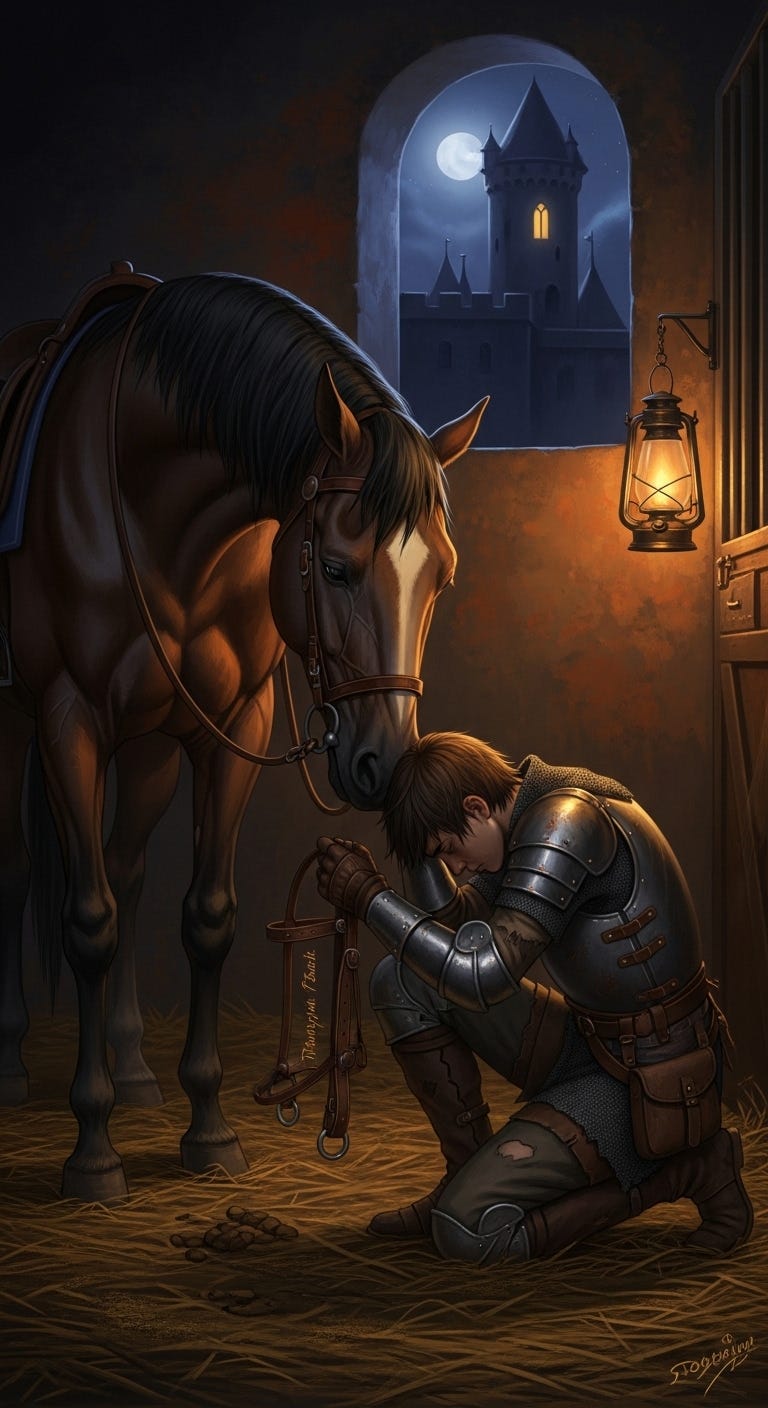
That night, he knelt beside it in the stable.

“Old friend,” he said. “I am not able

To win her with a sword. But I can sing.

Tomorrow, I will give the rich prince a thing

He cannot buy: ten poems. And you, my horse,

Will stand here silent. That will be your force —

To witness. To remember. To not speak.

Because the poor must let the wealthy seem meek.”

**IV. The Second Poem — Written on a Bridle Strap**

*My horse knows the way to your window, not to the war.*

*His hooves have memorized the stones outside your door.*

*He never carried a lance. He never wore a plume.*

  • He only carried me through the sorrow and the gloom*

*To stand beneath your balcony at three o’clock in spring,*

*When even the richest men are poor at listening.*

*So if you hear a hoof-fall soft as fallen ash,*

*That is my silent horse. That is my quiet dash*

*Toward a love that has no armor, no land, no king to please — *

*Just a horse who knows your window, and a heart down on its knees.*

**V. The Meeting in the Garden**

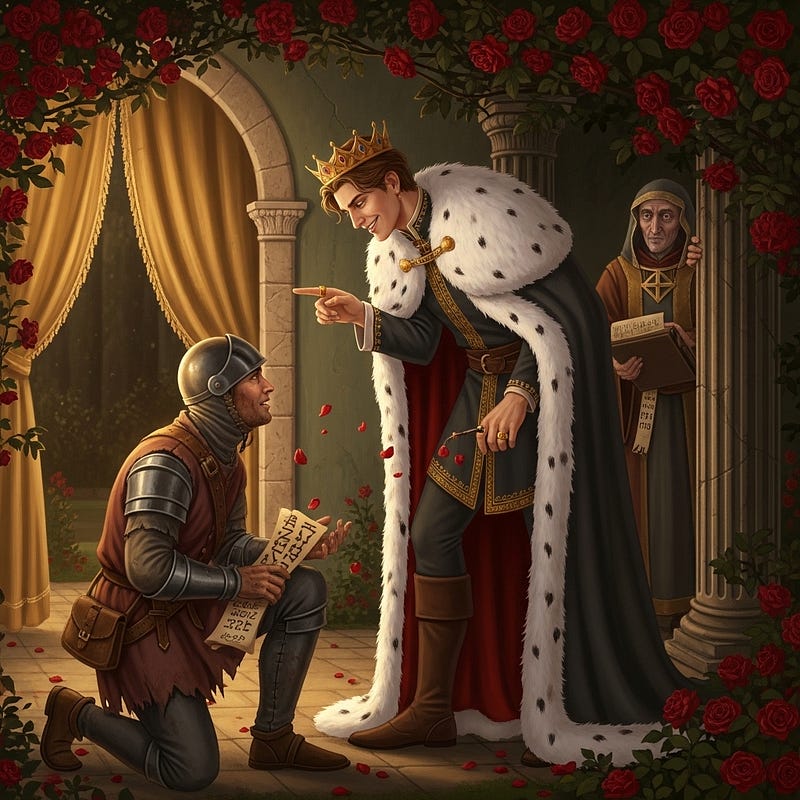
Rich Partner found Poetry by the rose hedge.

“You,” said the prince. “The one who lives on the edge

Of starvation. I heard you make rhymes.

I need ten love poems for wedding times.

Medium is strange. She wants ‘feeling,’ not gold.

Make me ten verses. Let my story be told

As if I wrote them. Hide behind the curtain.

Sing. I’ll move my lips. Of this be certain —

You will be paid.” Poetry bowed his head.

“I ask no gold,” he said. “Just let me stay instead

Behind the cloth. Let my voice reach her ears.

That is my price. Ten poems. Ten tears.”

**VI. The Father Watches**

Manager stood behind a column. Stone.

He saw his son. He heard the prince’s tone.

“This is my chance,” he whispered to his purse.

“If Poetry shames me, I will make it worse.

I will fire him. Not once. But poem by poem.

Ten chapters of dismissal. I will show him

That love is nothing. Numbers are the law.”

He touched his ledger. Smiled. And saw.

**VII. The Silent Horse Witnesses**

Back in the stable, the horse did not move.

But animals understand what words cannot prove.

It lowered its head. It breathed on the floor.

It remembered the boy who could not afford

A saddle, a blanket, a bridle of leather —

Only a whisper: *We will survive this weather.*

The horse closed its eyes. In the dark of the stall,

It saw a princess. It saw her fall

Not for a prince with camels and rings,

But for a poor man who sings.

**VIII. The Promise Before the Curtain**

That midnight, Poetry sat by the well.

He wrote the second poem. He could not tell

If Medium would hear his voice behind the cloth,

If she would know the rich man’s mouth was both

A liar and a thief. But he had to try.

“Tomorrow,” he said to the moon, “I die

Or live. There is no middle for the poor.

Either she knows my voice, or I close the door.”

He folded the bridle strap. He hid it inside

His shirt, next to his heart. And then he cried —

Not from sadness. From the terrible weight

Of loving someone when you have no estate.

**IX. The Closing of Chapter Two**

So ends the second chapter. The rich prince smiles.

The poor knight sharpens his voice for ten miles

Of verse. The silent horse stands in the straw.

Manager sharpens his ledger like a claw.

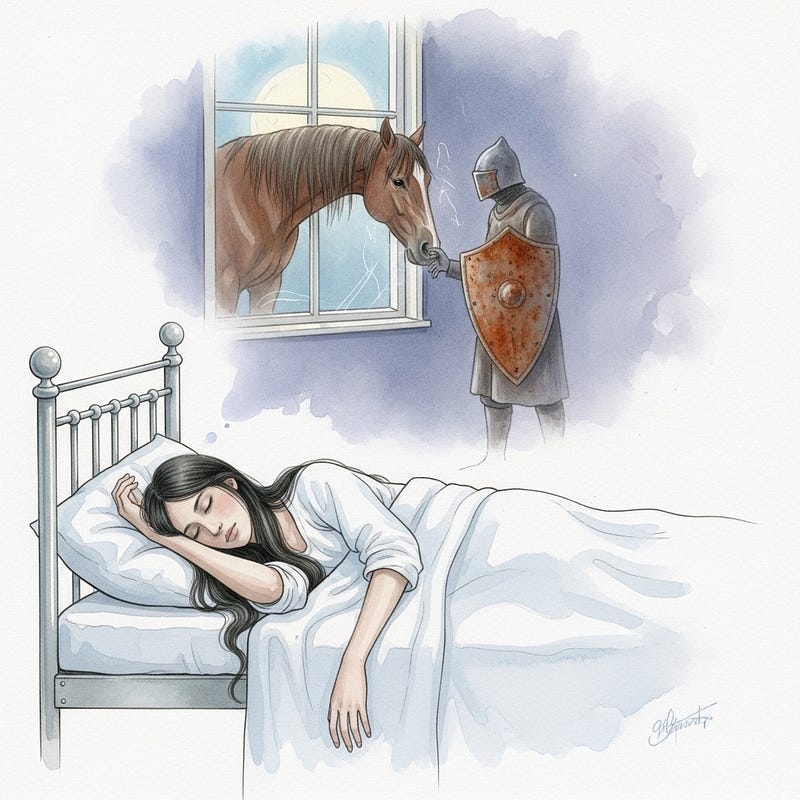
And Medium, asleep in her silver bed,

Dreams of a rusted shield and a horse’s head

Nuzzling her window at three in the dark.

Somewhere, a poor boy strikes a match. A spark.

The curtain waits. The ten poems are nearly done.

get 50 % discount with “memo” code in 


https://sites.google.com/view/payhipbooks-discount/home

for limit time


colored book “in “https://sites.google.com/view/payhipbooks-discount/health" with code “memo” to get 50%discount for all books for limit time


get books with half price with code “memo “ in “https://sites.google.com/view/payhipbooks-discount/home

be Millonaire “ “https://sites.google.com/view/be-miolllopn/home

Sunday, June 7, 2026

The Rusted Knight: Ten Poems of a Poor Lover (Poetry & Medium Book 1)


The Rusted Knight: Ten Poems of a Poor Lover (Poetry & Medium Book 1)

**Chapter 1**: *The First Poem — The Rusted Shield*

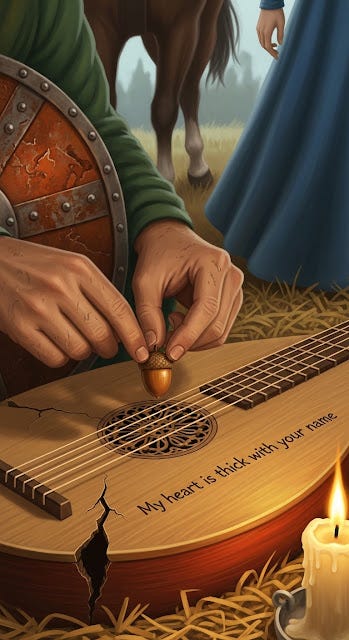
He wrote: *“My armor is thin, but my heart is thick with your name.”*

**Chapter 2**: *The Second Poem — The Silent Horse*

*“My horse knows the way to your window, not to the war.”*

**Chapter 3**: *The Third Poem — The Moon’s Confession*

*“The moon is poor like me, yet you love its light.”*

**Chapter 4**: *The Fourth Poem — The Invisible Crown*

*“I never wore a crown, but you made me a king of a single glance.”*

**Chapter 5**: *The Fifth Poem — The Well of Echoes*

*“Every word I never said lives in this well. Listen.”*

**Chapter 6**: *The Sixth Poem — The Thread of Medium*

*“You are not too hot, not too cold — you are the exact temperature of home.”*

**Chapter 7**: *The Seventh Poem — The Dance of the Poor*

*“Let me dance with you in rags. Velvet lies. Rags remember.”*

**Chapter 8**: *The Eighth Poem — The Secret Wedding*

*“We are already married in a place no rich man can enter.”*

**Chapter 9**: *The Ninth Poem — The Voice Behind the Curtain*

*“If I must hide, I will hide inside my love for you.”*

**Chapter 10**: *The Tenth Poem — The Fire of the Fired*

*“They will burn me away. But ashes still spell your name.”*

Rich Partner read the poems. His eyes glittered with greed. “Perfect. Tonight, you will sing them. But you will hide behind the throne room’s tapestry. I will move my lips. You will sing. And she will think it is me.”

That night, the court gathered. Torches flickered. Princess Medium sat on her silver chair, bored and sad. Rich Partner stood before her. Behind the heavy curtain, Poetry began to sing in a low, trembling voice.

Rich Partner moved his mouth carefully — too carefully. His lips were like a puppet’s. But the voice… the voice was fire and rain together.

Princess Medium closed her eyes. Then opened them.

“That voice,” she whispered. “That is not the voice of a rich man. That is the voice of a man who has nothing but love.”

She rose slowly. She walked toward the curtain. Rich Partner froze. The guards reached for their swords, but Medium raised her hand.

She pulled the curtain aside.

There stood Poetry — thin, poor, trembling, still singing the tenth poem.

*“They will burn me away. But ashes still spell your name.”*

She hugged him. In front of everyone. In front of the king, the prince, the court.

“You,” she said. “Only you.”

Rich Partner left in rage. The king was confused. But then **Manager** — Poetry’s own father — stepped forward. Manager was the king’s chief overseer, a cold man who valued order and coin. He hated Poetry’s dreams.

“You have shamed this house,” Manager said. “You will be fired. Not once. But in ten chapters of poems — each poem a dismissal.”

And so Manager recited:

1. *Fired for loving without gold.*

2. *Fired for singing without permission.*

3. *Fired for being poorer than your voice.*

4. *Fired for making a princess choose rags.*

5. *Fired for hiding behind curtains of truth.*

6. *Fired for believing love is enough.*

7. *Fired for embarrassing the system.*

8. *Fired for not becoming rich.*

9. *Fired for making Medium feel.*

10. *Fired for being Poetry.*

But as Poetry walked out of the hall, Medium took his hand. She walked with him.

“Where will you go?” asked the king.

“To a small cottage,” she said. “Where we will have no gold — but ten poems on the wall, and a love that cannot be fired.”

And they lived, not richly, but truly.

The End.

## Chapter 1: The First Poem — The Rusted Shield

**I. The Naming of the Knight**

They called me Poetry, not for verses penned,

But for the shape my silence took at night —

A bent man walking where the road would end,

Whose only wealth was hunger for the light.

My horse had ribs like ladders, my sword a ghost,

My shield a disk of iron eaten red.

The other knights drank wine and raised a toast

To battles won. I raised a word instead.

**II. The Vision of Medium**

She came on Tuesday when the rain was thin,

A princess made of balance, not of fire —

Her name was Medium, held somewhere within

The place where doubt and faith both expire.

She wore no crown that dazzled. Just a band

Of silver touched with fingerprints of use.

She did not wave. She held out one bare hand.

I dropped my rusted shield into the goose-

Filled courtyard pond. The splash was my first vow.

She smiled. The kingdom turned to water then.

I thought: *A poor man has no right to bow*

*Before a princess.* But I bowed. Amen.

**III. The Rusted Shield Speaks**

My shield said nothing — metal cannot talk.

But rust is language. Every orange stain

Was a small war I lost on some rough walk,

A bridge I crossed and could not cross again.

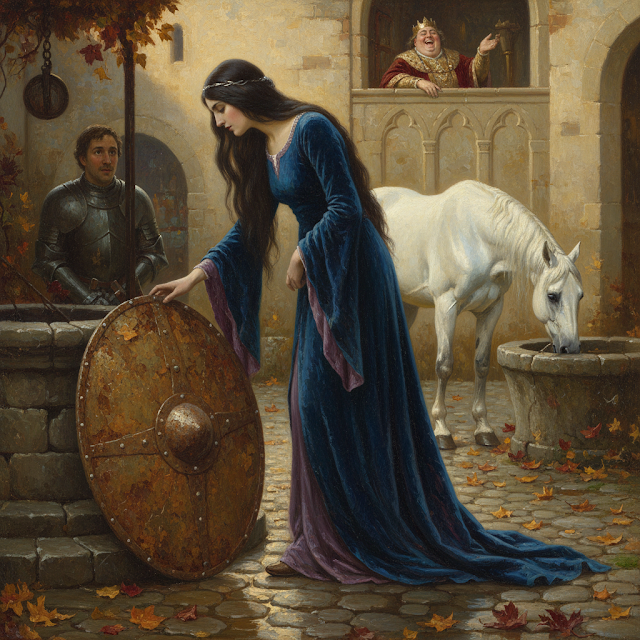
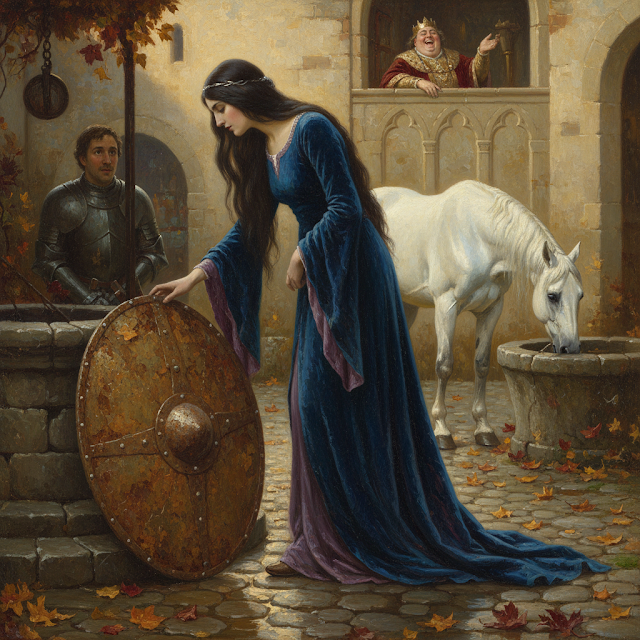
I leaned it by the stable door at dusk.

The groom said, “Throw that thing into the fire.”

But Medium walked past, and in the musk

Of wet hay and October, something higher

Moved through her eyes. She touched the ruined edge.

“This shield,” she said, “has loved. It did not win.

That is the same thing as a wedding pledge

To anyone who knows where love begins.”

**IV. The Poor Man’s Arithmetic**

What does a poor knight count? Not gold, not land.

He counts the seconds she looks left, not right.

He counts the steps between her chair and hand.

He counts the colors of her dress at night —

Tonight was blue like river after rain,

Tomorrow gray like doves against a cloud.

He adds the times she almost said his name,

Subtracts the wall of courtiers, proud and loud.

The sum is always zero. Zero is

The number of his horses, coins, and lands.

But zero, when arranged like two loose keys,

Can open any lock where hope still stands.

**V. The First Poem, Written on a Leather Strap**

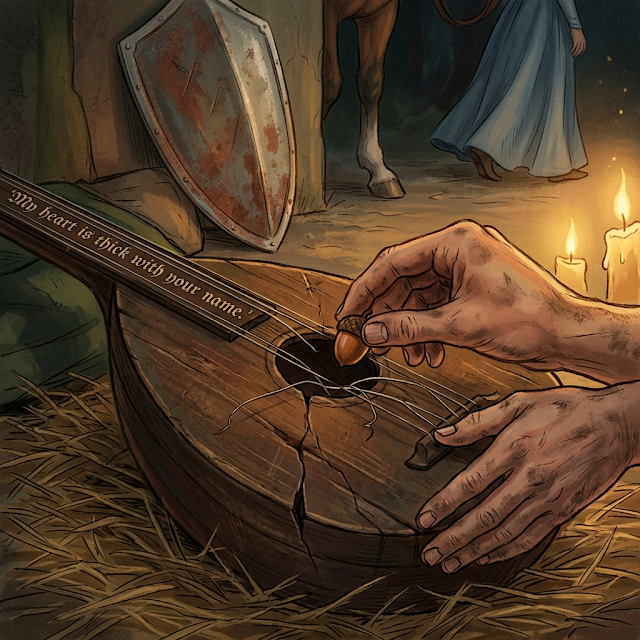
*My armor is thin, but my heart is thick with your name.*

*Rust is my heraldry. Silence is my claim.*

*I fought no dragon. I slew no enemy king.*

*But I carried your shadow home in a broken sling.*

*Take me as I am — a shield that cannot protect,*

*But a shield that remembered where you placed your neck*

*When you leaned down once to tie your silver shoe.*

*My heart is thick with you. My armor thin with you.*

**VI. The King’s Distant Laughter**

The king did not know. No king ever knows.

He sat on a chair of antlers and old gold,

Watching his daughter smell a winter rose.

He thought: *She will be married. I am old.*

He did not see the knight behind the well,

Scraping a poem into a piece of bark.

He did not hear the story the rust could tell —

That love begins the moment light turns dark.

The courtiers laughed at Poetry’s torn cloak.

The jester made a joke about his horse.

But Medium, inside the royal smoke,

Moved her hand in circles. No one saw, of course.

**VII. The Promise Before the Rich Prince Came**

Before Rich Partner’s camels crossed the hill,

Before the ten poems were a bleeding task,

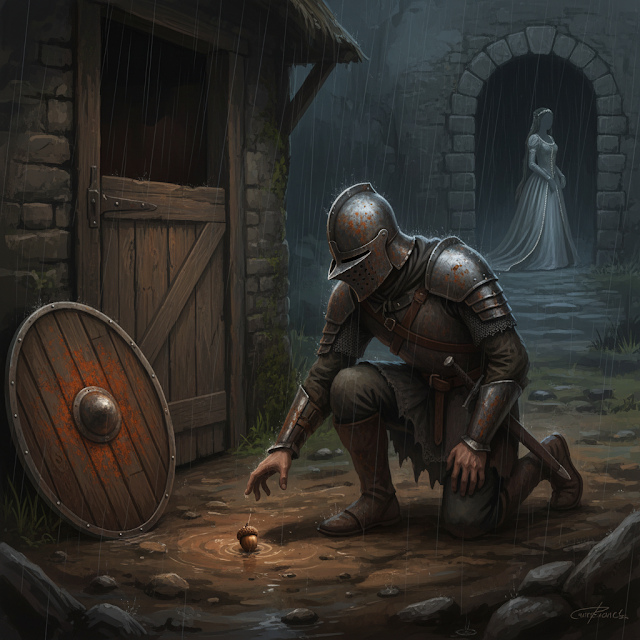
Poetry knelt by the rusted shield, quite still.

“You were my father’s,” whispered he. “Now ask —

Ask me to be worthy of one glance.

Ask me to turn my poverty to art.”

The shield said nothing. That was the only chance

A poor man needed. He placed it on his heart.

Then Medium passed again. She did not speak.

She dropped a single acorn by his boot.

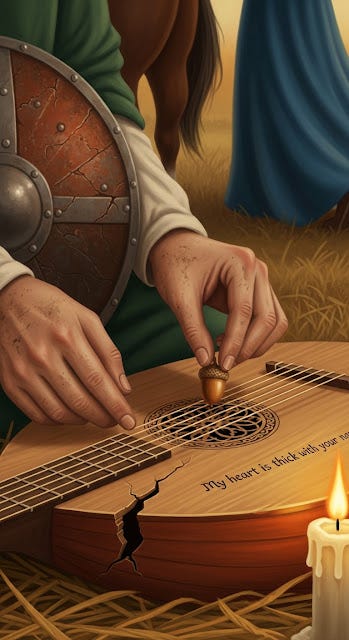
He picked it up. His fingers felt so weak.

He planted it inside a broken lute.

**VIII. The Closing Stanza of Chapter One**

So begins the story of the poor knight Poetry,

Whose shield was rust, whose horse was air and bone,

Who loved a princess named Medium — truly,

And had no wealth to offer but his own

Ten fingers carving verses into walls,

Ten toes that walked through mud to see her comb

Her hair by candlelight in secret halls.

The rich prince came. The father made his foam

Of anger. But before the fall, the fire,

The ten dismissals, the hiding and the song —

There was a rusted shield and one desire:

*To love where loving had no right to belong.*

colored book “in “https://sites.google.com/view/payhipbooks-discount/health" with code “memo” to get 50%discount for all books for limit time


get books with half price with code “memo “ in “https://sites.google.com/view/payhipbooks-discount/home

be Millonaire “ “https://sites.google.com/view/be-miolllopn/home